
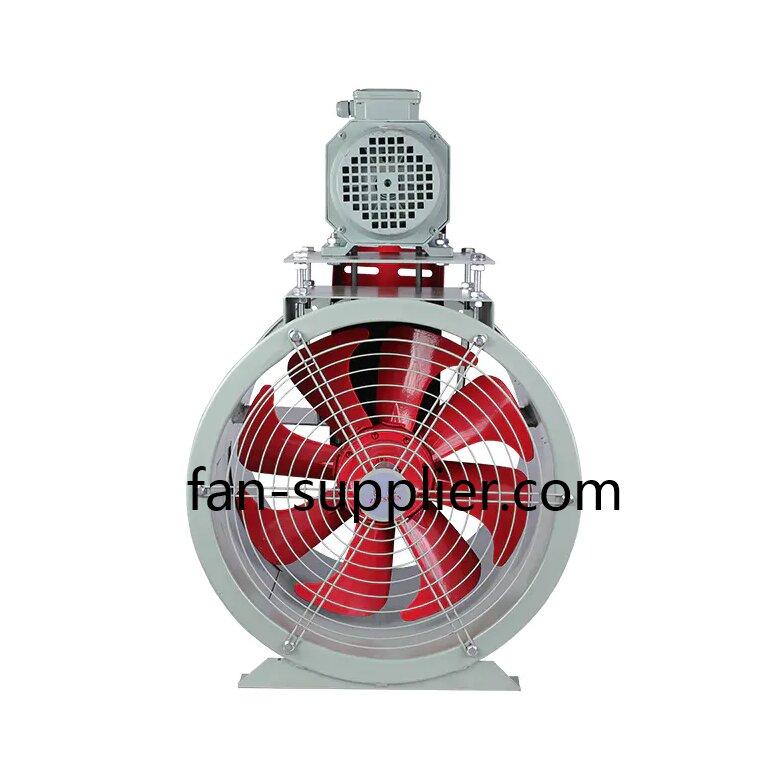
Industrial ventilation depends on equipment that can move air effectively while fitting the layout and operating conditions of a facility. When evaluating an OEM Industrial Fan Manufacturer, buyers should consider how material selection, mechanical construction, airflow requirements, installation, and product design work together. Zhejiang Shenli Explosion proof Electromechanical Co., Ltd. produces axial-flow fans, centrifugal ventilation fans, explosion-proof fans, and other ventilation equipment for different industrial and commercial applications.
Material selection is an important starting point because fan components encounter different operating conditions. The housing must provide a suitable structure for the working environment, while the impeller needs to maintain its form as it moves air. Carbon steel is commonly used in industrial equipment where structural strength is important. Stainless steel may be considered for environments where corrosion resistance is a priority, while fiberglass-reinforced plastic and other suitable materials can be relevant to certain corrosive applications. The right choice depends on the air being handled, surrounding conditions, and maintenance expectations.
The motor and electrical components also deserve attention. Winding materials, insulation, bearings, and protective enclosures contribute to the overall construction of the fan assembly. For equipment operating in demanding environments, buyers should confirm that the selected motor and fan configuration are appropriate for the intended conditions. Material choices should be assessed as part of the complete unit rather than as isolated features.
A purchasing decision should begin with the purpose of the ventilation system. Some facilities need general air circulation to reduce stagnant areas, while others require localized extraction near production equipment. Warehouses may need air exchange, and industrial processes may call for exhaust handling or induced-draft ventilation. Defining the actual task helps buyers determine whether an axial-flow fan, centrifugal fan, exhaust fan, or another configuration is suitable.
The surrounding system is equally important. Ductwork, bends, filters, outlet positions, and the arrangement of nearby equipment can influence how air moves through a facility. A fan selected without considering these factors may not integrate smoothly with the wider ventilation design. Buyers should share relevant layout information and describe the operating environment before finalizing their equipment choice.
Fan technology connects mechanical design with airflow behavior. Axial-flow fans move air generally along the direction of the rotating shaft, making them useful in many ventilation and air-exchange arrangements. Centrifugal fans guide air through the impeller and redirect it toward the outlet, making them relevant to systems where duct resistance and pressure requirements must be considered. Neither type is universally suitable for every application; the selection should reflect the system's actual needs.
Impeller geometry, blade arrangement, motor coordination, and rotational balance all contribute to fan operation. An impeller must interact appropriately with the air while remaining mechanically stable during movement. Careful assembly and balancing can help manage vibration, while suitable motor integration supports the intended operating behavior. These details are particularly relevant when fans are expected to work as part of a larger production or environmental-control system.
For applications where potentially hazardous atmospheres may be present, equipment selection requires additional care. Explosion-proof fans should be chosen according to the conditions and protection requirements of the installation, rather than simply by their product name. Buyers need to confirm the suitability of the complete equipment for the relevant environment and follow applicable installation and operating requirements. Zhejiang Shenli's product range includes explosion-proof axial-flow and ventilation fan options for specialized industrial applications.
User experience begins with the practical tasks surrounding the fan. Installers need access to mounting points, electrical connections, and relevant service areas. Maintenance personnel benefit when components can be inspected without unnecessary disruption to nearby equipment. Clear connection arrangements and a well-planned installation position can make commissioning and routine checks easier to manage.
Noise and vibration also influence the working environment. Their effects can depend on fan design, installation quality, airflow conditions, and the surrounding structure. Appropriate equipment selection, secure mounting, and consideration of nearby workstations can help buyers address these concerns during system planning. Maintenance teams should also be able to check for unusual vibration, loose connections, dust accumulation, and other changes that may affect operation.
Cleaning and maintenance requirements vary with the type of air being handled. Fans used in dusty workshops may need regular inspection of the impeller and housing, while equipment exposed to corrosive substances requires particular attention to material condition. Easy access to inspection points can make maintenance more practical. Buyers should consider the available service space and the maintenance routines their teams can realistically follow.
Design and appearance also have a functional role. A compact housing may suit a restricted installation area, while a duct-mounted or wall-mounted arrangement can support a particular ventilation layout. Protective finishes, orderly cable routing, accessible fasteners, and a clearly arranged exterior can help simplify handling and integration. For OEM projects, these design details may need to align with the appearance and structure of the finished machine or facility.
Customization can be useful when a standard product does not fully match the application. Buyers may need a different mounting arrangement, housing material, airflow direction, or coordination with an existing ventilation system. Zhejiang Shenli Explosion proof Electromechanical Co., Ltd. describes its business as including research and development, production, and customized fan solutions. Early discussion of the working environment, installation layout, and maintenance expectations can help the supplier understand the intended use more accurately.
For more information about Zhejiang Shenli Explosion proof Electromechanical Co., Ltd., its axial-flow fans, centrifugal ventilation fans, explosion-proof fans, and related ventilation products, visit https://www.fan-supplier.com.

 Arabic
 French
 Spanish
 Portuguese
 Deutsch
 Turkish
 Dutch
 Italiano
 Russian
 Romaian
 Portuguese (Brazil)
 Greek