
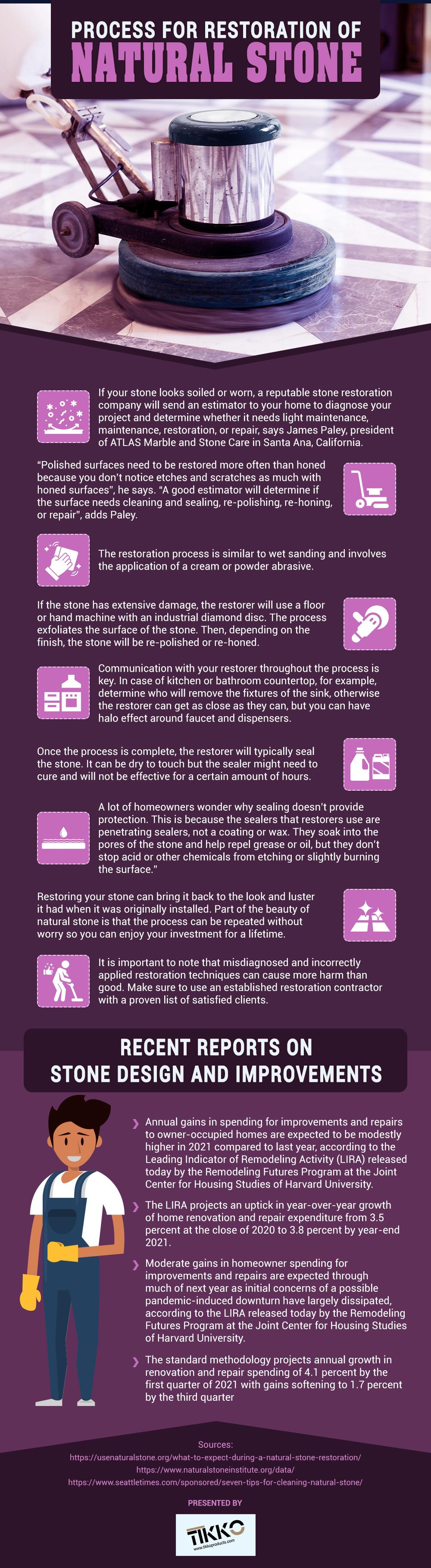
The infographic, “Process for Restoration of Natural Stone,” explains how professional restoration can revive the appearance and condition of natural stone surfaces such as marble, limestone, and granite. Natural stone is widely used for flooring, countertops, backsplashes, patios, and other decorative areas because of its distinctive appearance and durability. However, its porous and sensitive nature can make it vulnerable to scratches, stains, moisture, chemical exposure, heavy foot traffic, and general wear.
The restoration process begins with assessing the type and condition of the stone so that suitable products, equipment, and techniques can be selected. The surface is then thoroughly cleaned to remove accumulated dirt and contaminants before damaged or uneven areas are treated. Depending on the condition of the stone, restoration may involve grinding, honing, polishing, stain removal, or repairing cracks and imperfections. Polishing helps restore the stone’s natural shine and smoothness, while sealing provides additional protection against moisture, staining, and everyday deterioration.
Proper restoration not only improves appearance but also helps preserve the structural integrity and service life of the material. Overall, the infographic emphasizes that careful cleaning, surface correction, polishing, and protection can successfully restore worn natural stone and maintain its natural beauty for many years.

 English
 French
 Spanish
 Portuguese
 Deutsch
 Turkish
 Dutch
 Italiano
 Russian
 Romaian
 Portuguese (Brazil)
 Greek